On 18th March 2025, a news item aired on NTV (Kenya) as part of their 9:00pm bulletin. With the byline In Search of Rains and Children, the bulletin centred on the Ilchamus community who are found in Baringo South, within Kenya’s Rift Valley. A Maa-speaking community, the Ilchamus practice agro-pastoralism and are known for their rich traditional culture which includes beadwork and colourful outfits. The report was about special prayers that were conducted by elders from the community, accompanied by other members, praying for rain and for the fertility of barren women, that they would conceive.
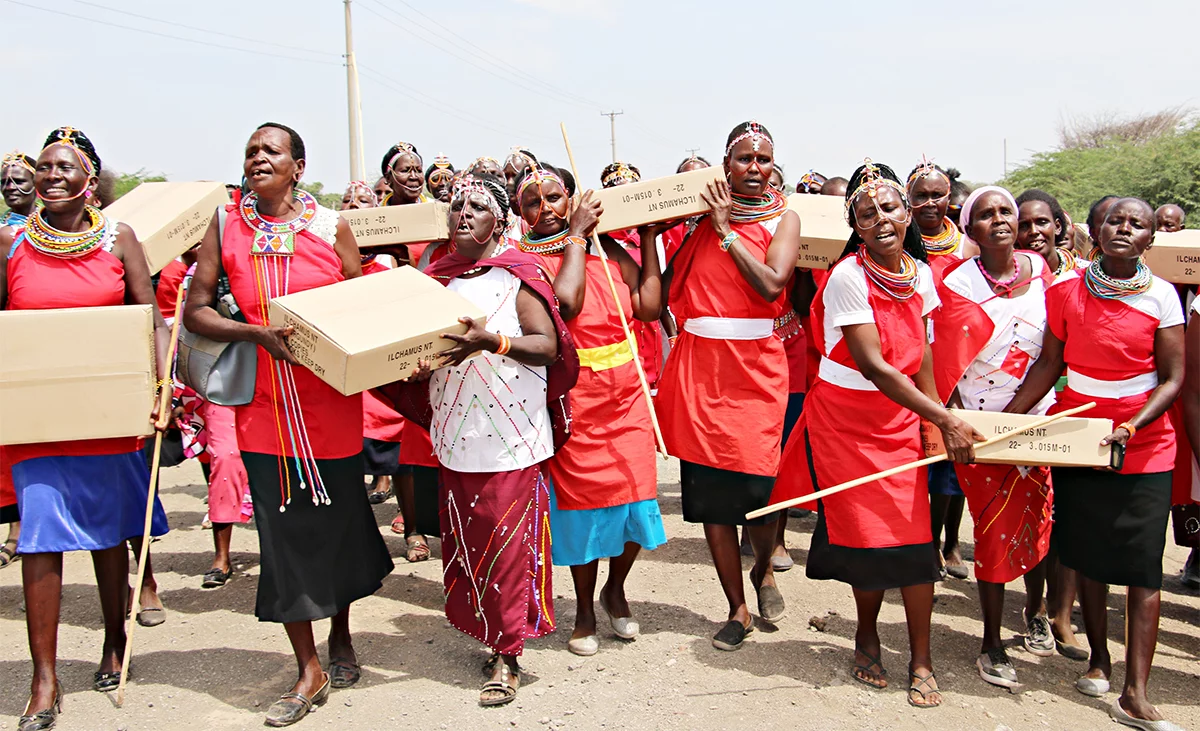
A group of Ilchamus women carrying boxes of Bibles that have been translated into their language. Photo: Courtesy Wycliffe Bible Translators
The prayers on the blessings of children are carried out by elderly women. The women march to a nearby riverbank that has a sycamore tree. Here, they tie grass around the neck of the woman struggling with infertility, a gesture of hope that she will conceive. They then go to a nearby hot spring where mud is smeared on the woman’s forehead. Women who have also only given birth to female children are included in the prayers. In a different location are parallel prayers by the male elders, praying for rain. The news item was shared by NTV journalist, Margaret Kibathi.
The journalist used several techniques. First was immersion, where the team actually went out and took part in the ceremony. They also did video coverage, conducting interviews with some of the elders who were leading in prayers, and also with some of the women who were hoping for the miracle of being mothers in the foreseeable future. All this was captured on camera.
The report covered several themes. For instance, the contrast between tradition vs modernity when it comes to customs such as weather forecasting and fertility. The issue of childlessness was also brought out, making it clear that a (married) woman without a child was seen as more of an anomaly within the community. Interestingly, the issue of male impotence was not mentioned, which can lead to an assumption that women are the only contributors of childlessness in marriage. The place of the girl and boy child in the community also features, with women who have children but just girls also being prayed for. This brings the illusion that girls and boys do not hold the same value.
With this broadcast, the journalist opened a conversation into the place of faith in bringing hope to vulnerable populations, in this case, women without children. It also touched on the stigma that barren women are subjected to within our communities, as well as the place of traditional medicine and customs in dealing with issues. Culture and science also go hand in hand, as the men also plant trees after their prayers, to help combat the effects of climate change. It was also evident that, in addition to being a cultural practice, the ceremonies were a way of fostering unity within the community.